Moe’s mission to schools
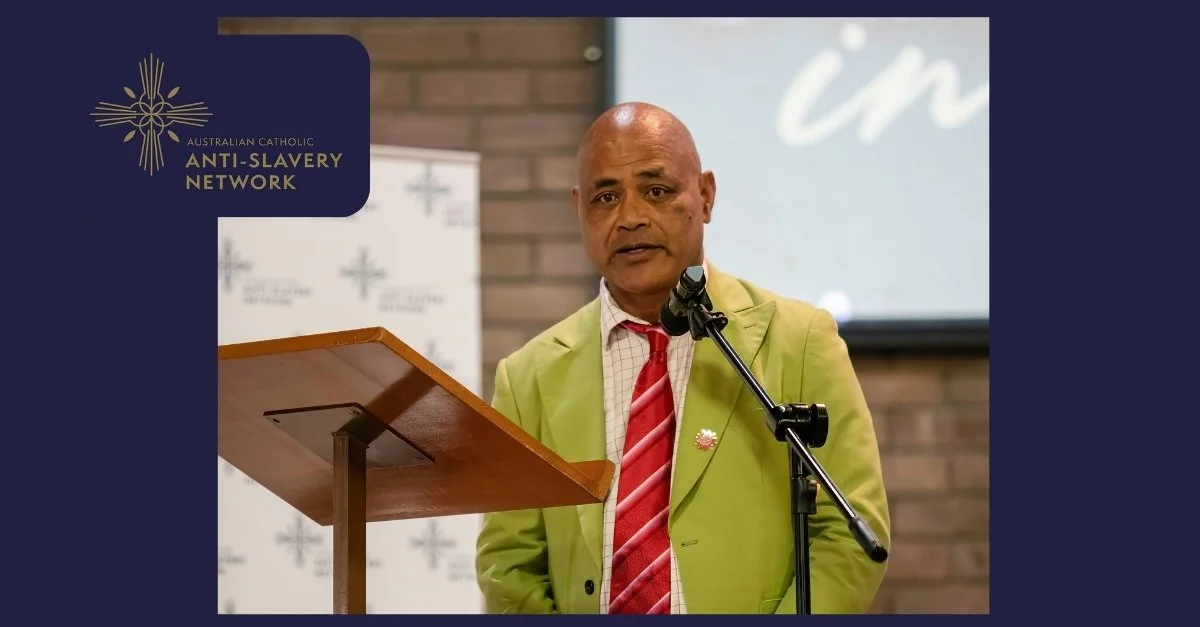
Lived Experience Advisor Moe Turaga is taking his message about modern slavery to Catholic schools
Moe Turaga has been telling his personal story of modern slavery since 2017.
In his work for the Australian Catholic Anti-Slavery Network, Moe has told his story all over Australia and around the world.
Through Moe’s many speaking engagements, he has become the human face of modern slavery in Australia. He has spoken at Parliamentary inquiries, to ASX-listed companies, and at the United Nations Business and Human Forum in Geneva.
But now he wants to tackle a much wider audience by raising awareness of Australia’s 830,000 Catholic high school students.
“There is more attention than ever on modern slavery and forced labour, but there are still so few people who recognise the signs, let alone know how to respond,” Mr Turaga said.
“The Asia-Pacific region we live in is rife with forced labour scams, and barely a week goes by without another revelation of exploitation in our supply chains. Yet there is no plan to educate young Australians about modern slavery and forced labour, despite young people being one of the most vulnerable groups to exploitation.
“In my work for ACAN, I will be reaching out to all Australia’s Catholic school systems over the next 12 months, to schedule workshops on modern slavery and forced labour. I want to share my story with as many young people as possible, to help them avoid falling into the same trap I was caught in, when I first came to Australia,” Mr Turaga said.
Moe Turaga’s call to action coincides with 30 July – the United Nations World Day against Trafficking in Persons.
Modern Slavery Liaison Officer at Sydney Catholic Schools, Greg Basford, has heard Moe tell his story on numerous occasions.
"Moe's journey from modern slavery survivor to passionate anti-slavery advocate is an inspiration. Every Catholic educator should hear his story," Mr Basford said.
Catholic leaders are among the strongest global voices against modern slavery and human trafficking.
Pope Leo XIV’s first Encyclical Letter, Magnifica Humanitas, published a whole section on “Breaking the chains of new forms of slavery.” (Sections 173-181). The Encyclical also proposes an “An educational alliance for the digital age” (Sections 139-142), arguing “The central role of schools” (Sections 143-147).
“Catholic leaders around the world and in Australia are leading the way,” Mr Turaga said.
“And when it comes to compliance with Australia’s Modern Slavery Act, Catholic organisations are following that lead.
"But what ACAN does is much more than compliance. We are building communities of practice to prevent modern slavery, and we are helping people at risk of labour exploitation.”
ACAN Program managers uploaded 50 Modern Slavery Statements covering more than 150 Catholic organisations to the Federal Government’s Modern Slavery Statement Register on 30 June 2026, in compliance with Australia’s Modern Slavery Act.
The statements capture the efforts and activities undertaken by designated Modern Slavery Liaison Officers and working groups at each Catholic organisation. The statements cover Catholic dioceses, school systems, health, hospital and aged care providers, community and social services agencies, and universities.
Under the Modern Slavery Act any organisation operating in Australia with an annual consolidated revenue of over $100 million is required to submit an annual Modern Slavery Statement.
Mr Turaga also reminded ACAN member organisations of the Domus 8.7 Remediation Service available to them, which includes a 24/7 Careline for staff who encounter someone who may need assistance.
The Domus 8/7 Careline is staffed by trained counsellors, and callers can access the national Translating and Interpreting Service if needed.
Catholic Archdiocese of Sydney - Modern Slavery Awareness Raising - guest speaker booking flyer
CSNSW - Modern Slavery Awareness raising in Catholic schools - guest speaker booking flyer