
Taking a harder line on modern slavery
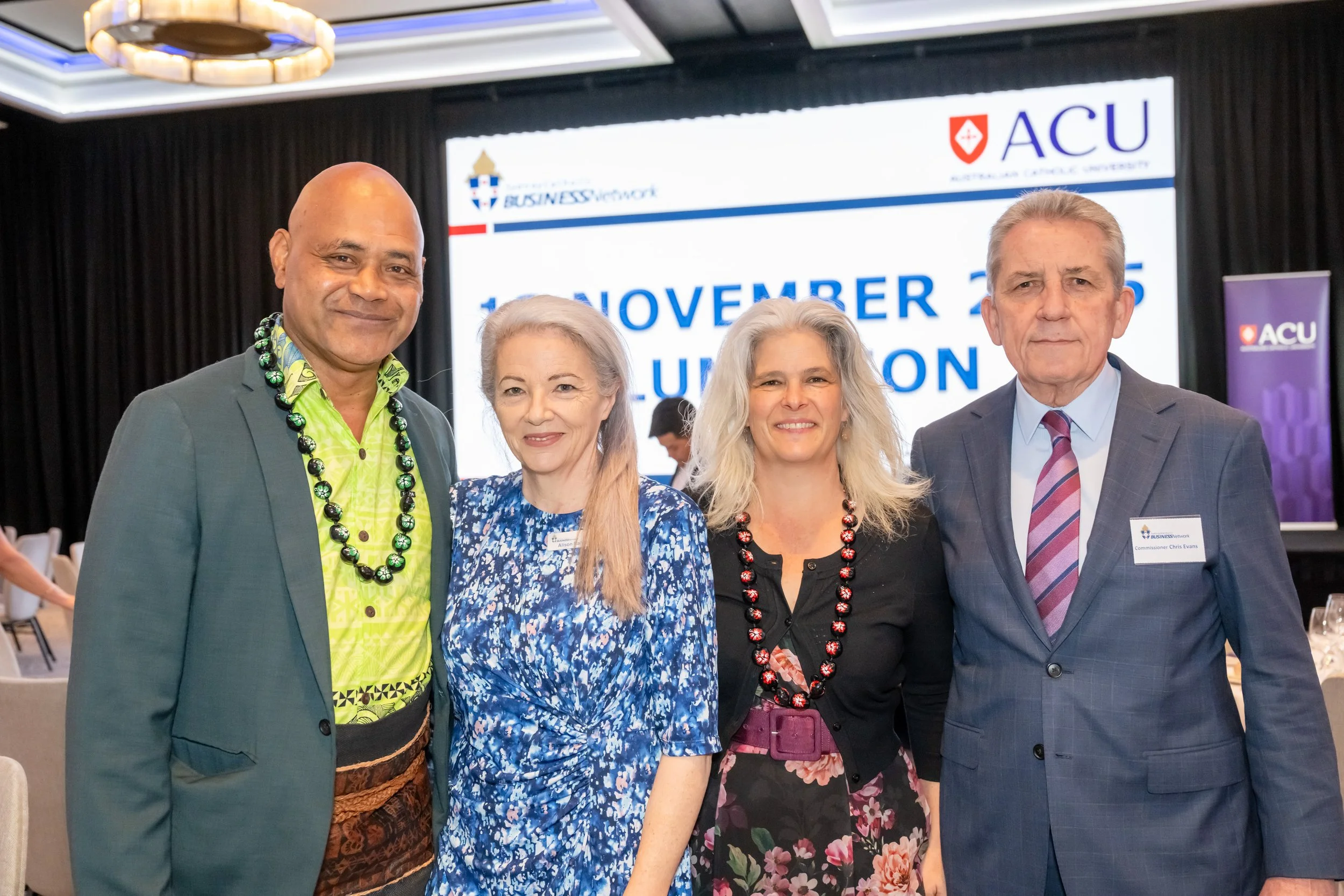
ACAN team members Moe Turaga, Alison Rahill and Jenny Stanger with Australian Anti-Slavery Commissioner Chris Evans
The Catholic agency providing remediation to victims of modern slavery has called for penalties against organisations who fail to comply with Australia’s Modern Slavery Act.
Domus 8.7 Lived Experience Lead Moe Turaga said the Federal Government needs to get serious about holding organisations who have not implemented basic modern slavery risk management to account.
“The Modern Slavery Act has been in place for seven years now. Yet there are still large companies in high-risk sectors who are ignoring the risks of modern slavery in their operations and supply chains,” Mr Turaga said.
“While many companies have engaged with the Act in good faith, too many have overlooked their reporting responsibilities.”
There are currently no penalties in the Modern Slavery Act for failure to report or for poor-quality reporting.
“This cannot continue. At Domus 8.7, we see firsthand the misery caused by some of the most extreme forms of labour exploitation,” Mr Turaga said.
“Seven years is long enough to establish a culture of compliance. We now need significant consequences for organisations who choose not to comply. The Australian Securities and Investment Commission can impose penalties of up to $16.5 million on companies who breach corporate laws. Non-compliance with the Modern Slavery Act should attract the same level of penalties.”
This week the Federal Attorney General’s department has resumed consultations with industry stakeholders on ways to strengthen Australia’s Modern Slavery Act.
Ahead of the consultations, the Office of the Australian Anti-Slavery Commissioner released a position paper which substantially adopts three out of three key recommendations advocated for by ACAN/Domus 8.7 that fall within the scope of the consultation.
They include:
Mandatory modern slavery due diligence for reporting entities.
A regulator with enforcement powers to compel entities to comply with the Modern Slavery Act and seek civil penalties.
A requirement for the Australian Government to engage with the Act to the same standard as other reporting entities (businesses and not-for-profit organisations with an annual consolidated revenue of more than $100 million).
The Anti-Slavery Commissioner is proposing a two-year phase-in period for all reporting entities and a graduated approach to enforcement.
Domus 8.7 Executive Officer Alison Rahill has welcomed the Commissioner’s blueprint to strengthen the Modern Slavery Act.
“I applaud the Anti-Slavery Commissioner’s recommendations, and his pragmatic, risk-based focus to continuous improvement in business compliance. This approach reflects how the ACAN program has measured continuous improvement across our 50 member organisations,” Ms Rahill said.
“Including metrics and Board assurances that can be independently verified, similar to assurances required for mandatory climate reporting, must be built into any mandatory due diligence process.”
Catholic organisations in the ACAN program have published baseline data on members’ anti-slavery activities for the last four years, including referrals for remediation.
The ACAN Executive provides assurance to Bishops and boards of Catholic schools, universities, health and aged care and community services to ensure:
Supplier engagement activities to assess, address and mitigate the risks of modern slavery in operations and supply chains occurs.
Results of supplier engagement activities and self-reporting are accessible.
Linking of APSCA-certified ethical sourcing platform accounts to suppliers with real-time visibility of Self-Assessment Questionnaires, Social Audits and Corrective Action Reports.
Evidence of continuous improvement recorded in the baseline data table.
“As part of our annual Modern Slavery Statement reporting, we also include data and metrics to demonstrate compliance with the reporting criteria defined by the Act,” Ms Rahill explained.
Moe Turaga also welcomed the Commissioner’s focus on outcomes in the reporting process.
“As a person with lived experience of forced labour in Australia, the most important measure for me will be an increase in the identification and remediation of people in situations of labour exploitaiton,” Mr Turaga said.
“A national labour hire licensing scheme is a vital missing piece in the overall response to forced labour, the most common form of modern slavery,” Mr Turaga said, “However we understand that function sits outside the scope of the Government’s consultation.”